LABAPP LABAPP-202 Cdma Mobile Communication Trainer Kit LAB-202
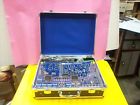
( Brand: Labapp ), ( Model: LAB-202 ), ( Type: Cdma Mobile Communication Trainer Kit ), ( Country/region Of Manufacture: India )
Review LABAPP Cdma Mobile Communication Trainer Kit
The LabApp-202 CDMA Mobile Communication Trainer Kit Lab-202 is an extensive and comprehensive educational tool designed for students and professionals seeking to understand the intricacies of CDMA (Code Division Multiple Access) mobile communication systems. This kit offers a hands-on learning experience, allowing users to explore and experiment with various aspects of CDMA technology in a controlled environment.
The LabApp-202 CDMA Mobile Communication Trainer Kit is equipped with a CDMA base station, CDMA mobile station, and a user-friendly software interface. The base station simulates a CDMA network, while the mobile station emulates a CDMA handset. These components enable users to study and analyze the principles of CDMA, including spread spectrum, soft handoff, and power control.
The kit includes various components such as antennas, cables, and power supplies, which are essential for setting up and operating the base station and mobile station. The software interface provides real-time monitoring and control of the system, allowing users to visualize and analyze the data transmitted between the base station and mobile station.
The LabApp-202 CDMA Mobile Communication Trainer Kit is suitable for a wide range of educational and professional applications. It is an ideal resource for students studying telecommunications engineering, computer engineering, or electrical engineering. It is also beneficial for telecommunications companies seeking to train their employees in CDMA technology.
In summary, the LabApp-202 CDMA Mobile Communication Trainer Kit Lab-202 is a powerful and versatile educational tool that offers a comprehensive and engaging learning experience in CDMA technology. Its user-friendly design, comprehensive components, and advanced software interface make it an invaluable resource for students and professionals alike.
Labapp-202 CDMA Mobile Communication Trainer Kit (Lab-202) is a laboratory equipment designed for teaching and learning about CDMA mobile communication. Here are some pros and cons of buying this kit:
Pros:1. Hands-on Learning: The kit provides an opportunity for students to learn about CDMA mobile communication through practical experiments.
2. Comprehensive Coverage: The kit covers various aspects of CDMA mobile communication, including CDMA principles, CDMA networks, and CDMA handsets.
3. Real-world Application: The kit allows students to understand how CDMA technology is used in real-world mobile communication systems.
4. Cost-effective: Compared to building a similar setup from scratch, the Labapp-202 CDMA Mobile Communication Trainer Kit is a cost-effective solution.
5. Easy to Use: The kit is easy to set up and use, making it suitable for both beginners and advanced learners.
Cons:1. Limited Flexibility: The kit may not cover all the latest developments in CDMA technology, limiting its flexibility.
2. Expensive: Although it is cost-effective compared to building a similar setup from scratch, the kit may still be expensive for some individuals or institutions.
3. Limited Capacity: The kit may not be able to handle a large number of students simultaneously, requiring multiple kits for larger classes.
4. Limited Compatibility: The kit may not be compatible with all CDMA mobile communication systems, limiting its versatility.
In conclusion, the Labapp-202 CDMA Mobile Communication Trainer Kit is a valuable tool for teaching and learning about CDMA mobile communication. Its hands-on approach, comprehensive coverage, and ease of use make it an excellent choice for educators and students. However, its limited flexibility, cost, capacity, and compatibility are factors that should be considered before making a purchase. If these cons do not pose significant issues for you, then the Labapp-202 CDMA Mobile Communication Trainer Kit is a recommended purchase for enhancing your understanding of CDMA technology.
Details:
Kindly check in advance, to avoid any problem.
Transmitter receiver signal code speed: 1 knit, 2 knits optional spread spectrum 100kbit 200kbit gain: 50, 1 200 mode: direct modulation PS, DPs carrier frequency: 10.
specifications celltesequ:
- brand: Labapp
- model: Lab-202
- type: Cdma Mobile Communication Trainer Kit
- country/region of manufacture: India
Seller celltesequ:
- city: Hialeah, Florida
- zipcode: 33018
Ratings:
- reasonably priced not the best quality 08-12-17
- The product is great and the seller is quick reply for the product info 06-15-17
- Great product fast shipping 07-13-17
- Arrived today. Accurately described. Thank you. 06-13-17
- Fast! Thank you! 08-15-17
Returns celltesequ:
- time: 14 Days
- policy: returns accepted
- type: Money Back
- paid by: Buyer
Shipping celltesequ:
- type: Flat
- cost: $0.0
- handling: 4 days
Payments celltesequ:
- PayPal
Offer celltesequ:
- Sold: 0
- Started: October 30, 2017, 2:36 am
- best offer: true
- quantity: 2
- bids: 0
General celltesequ:
- businessindustrial > electricaltest equipment > test equipment business industrial > cellular test equipment test equipment
- condition: New
- in stock: Yes